
Emma
"Emma" by Jane Austen was adapted by Dulwich Players' members Emily Tarry-Wright and Hayley Blundell. It was an outdoor production set in the beautiful gardens of Bell House.
Clarisse Hassan
Ian Bavington Jones
James Ward-Parrish
Harvey Bassett
Holly Roselene
Joe Hartropp
Sophie Thompson
Callum Macphee
Rebecca Whaley
Tim Guest
Christ Stooke
Joe Hartropp
Gill Daly
Charlotte Holmes
Alice Kantor
Sybil Gimblett
Alfie Robinson
Charlotte Holmes
Michelle Lowe
Paul Grimwood
Hayley Blundell
Emily Tarry-Wright
Paul Grimwood
Nick Duquemin
Chloe Penfold
Heather Wilcox
Jane Jones
Denise Biffin
Maddy Jones
Michelle Lowe
assisted by Cast
& Dulwich Players Members
Lesley Hedley
Eleanor Orr
Michael Bradley
Clarisse Hassan
Rowan Jeffrey-Hall
Charlotte Holmes
Joanna Norman
Hayley Blundell
Reuben Folebendek
Emma Woodhouse
Mr Woodhouse
James
Mr George Knightley
Harriet Smith
Mr Martin
Mrs Anne Weston
Mr Elton
Isabella Knightley
Mr John Knightley
Mr Weston
Tom
Miss Bates
Mrs Bates
Patty
Jane Fairfax
Frank Churchill
Mrs Augusta Elton
Mrs Cole
Pianoforte
Co-Directors
Musical Director & Composer
Stage Manager
Choreography
Costume
Hair & Make Up
Front of House
Box Office Manager
Box Office Assistant
Set Design
Poster & Artwork Design
Photography
Publicity Co-ordinator
Rehearsal Prompt
Programme
Mini Assistant Director
CAST & CREATIVES
In order of appearance
'Emma'
Reviewed by Mark Kelleher

“Seldom, very seldom, does complete truth belong to any human disclosure” … and so the logical consequences of these lines played out in the latest instalment of Dulwich Players’ Bell House summer series; an original take on Jane Austen’s Emma, skilfully adapted by Emily Tarry-Wright and Hayley Blundell. Ostensibly a romantic comedy of manners centred around the exploits of the title character’s successes (or, moreover, failures) as a
matchmaker, the core of the story is rather more than that, providing lessons in love, maturity, self-delusion and the importance of making – and learning from – your mistakes. Tying these strands together into a performance that was witty and serious, light-hearted and eloquent, with characters that were both sympathetic and downright awful, demanded skill and poise from the actors and crew. They certainly rose to the occasion - supported by the secret co-star of the show; Bell House itself.


There was a good deal of plot to fit into just two-hours, but the writer-directors did a fantastic job of keeping the scenes short and sharp, with enough dialogue for each character’s quirks to reveal themselves without any unnecessary filler. And a good thing too; as actors and audience were having to contend with a petty punishing summer heatwave! From the get-go the characters and events came thick and fast, and the first act introduced us to most of the cast. In a part that seemed tailor made for him, given that he was seated and complaining most of the time, Ian
Bavington Jones was empathetic as the somewhat neurotic but big-hearted Mr Woodhouse (Emma’s father). Art imitated life as the part of ‘James’, the Woodhouse’s Butler, was played by James Ward-Parrish who by now seems almost a veteran in the players, and also appears to be staking a claim on an ambition to don every permutation of facial hair possible on stage in one DPs season. The steady and affable Mr Martin was played confidently by newcomer Joe Hartropp, who seemed surely a good match for Harriet, played by Holly Roselene… that is, until Emma got involved. I was particularly taken by Holly’s smooth tempo switches from a flattered interest in Martin, to a hint of


doubt, to outright rejection over just the course of a few lines of dialogue. It was excellently done and proof that her range extends far, far beyond being cast as teenage boys (take a hint, future directors).
Each act had at least one complete ass, and in act one that part was delivered with gusto by Tim Guest’s hilariously awful John Knightley, all bouncing curls and booming voice, with Rebecca Whaley as his wife Isabella running after him and trying to hold things together. Each act also had a great comedy turn, and this was delivered in the first half to much laughter in the crowd by Gill Daly as neighbour Miss Bates, Charlotte Holmes as her senile mother, and Alice Kantor as their suffering maid Patty. The parts were played somewhat as caricatures, but rightly so; in the context of a dialogue-heavy outdoor performance their set pieces provided a zing of spectacle and humorous energy and were a real highlight of the show.
A large amount of the plot revolved around Emma’s suitors old and new.
Despite professing his love for Emma, after being turned down, the rather changeable social climber Mr Elton, played artfully by Callum Macphee, returned with a new wife. Once more, Charlotte Holmes picked up a comedic prize for a bravura performance as his wife Augusta, who was rich, loud and, well, dreadful. Charlotte and Callum made a great comedy pair and provided a lot of laughs during the second act. A more serious suitor for Emma then appeared in the form of Frank Churchill, played by a suave Alfie Robinson. Frank took everyone’s hearts – particularly Emma’s – and appeared to be a very fitting suitor.


And why shouldn’t he be suitable, given his reputable background; his father played charmingly by Chris Stooke was a friend of the Woodhouse family, while his stepmother was Emma’s old governess Mrs Weston (nee Taylor). The latter character was a welcome back to the players for Sophie Thompson who delivered another brilliant and thoughtful performance; we hope to see more from her in future.
A fantastic set piece then provided us with a pivotal plot point. At a party hosted by Mrs Cole, played vibrantly by an irrepressible Michelle Lowe, a piano forte was gifted anonymously to the talented and intelligent Jane Fairfax played by a composed and enigmatic Sybil Gimblett. This set piece made excellent use of the house and the musical score with dancing inside – courtesy of the choreography of Chloe Penfold – visible through the windows of Bell House and Sybil miming piano playing with accompaniment in real time. It was a wonderfully composed, constructed, and acted scene.
The events following this intrigue opened the narrative of the play to some more emotional scenes in act 2, offering opportunities for the two lead
actors to really shine. Mr George Knightley, played excellently by newcomer Harvey Bassett, delivered a particularly devastating rebuke to Emma who had behaved unkindly to Miss Bates. Bassett’s delivery was extremely effective in getting across the wrenching of a man that was on the one hand conflicted by his obvious affection for Emma but was at the same time disappointed in her behaviour. At this point, the audience’s patience for Emma, played by Clarisse Hassan, was starting to wear thin – but Clarisse managed to win back our hearts in no time. As Emma began to understand her love for Knightley, it was also revealed that the affections of Frank Churchill were, in fact, pointed elsewhere.


Yes, he was too good to be true, and yes, it had something to do with that mysterious piano forte. These scenes where Emma comes to her realisation were very well done by Hassan who managed Emma’s transition to self-awareness naturalistically and empathetically.
Indeed, the actor that had the day was undoubtedly Clarisse Hassan in the part of Emma. While other actors have hammed up some aspect of Emma’s personality through arch comedy (all raised eyebrows and winks), or playing the part with over-the-top girlish confidence, Hassan opted for a touch more realism, candour and vulnerability in her characterisation of Emma. I think that paid dividends in the latter half of the play as it gave her Emma a greater emotional depth. It is a notoriously difficult role to play. Emma is famously a heroine that Austen didn’t expect anyone much to like – but Clarisse played the part beautifully – and was the uncontested star of the show.
…Well, not quite. Dazzling though the performances were, they were made all the more dazzling by the backdrop of Bell House itself, the brilliant use of the space and the huge amount of work put in by the stage crew.
First, on the staging, though having the audience look towards Bell House created quite a deep stage, which resulted in some projection issues for those playing further back, having the Georgian building as a backdrop was perfect for conjuring a Regency-era aesthetic. This staging also allowed cast members to make use of three entrances/exits (including through the house) and though those could run relatively long (due to distance), actors walking across the stage gave the audience something to look at during the scene changes. Indoors were created outdoors via Michael Bradley’s set design and some representative props – I particularly liked the multipurpose fireplaces – but the scene changes didn’t drag.
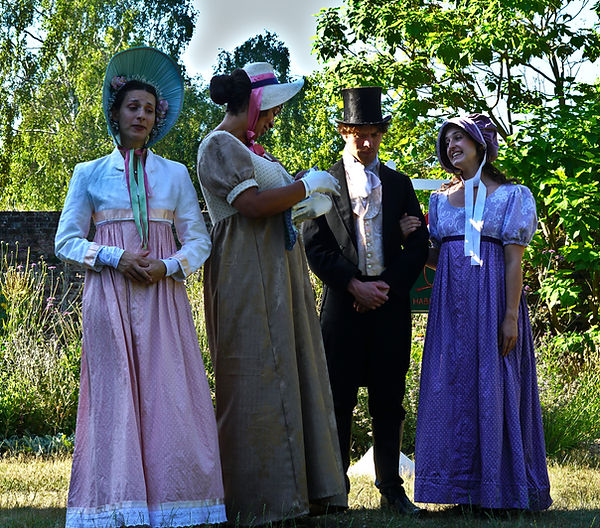

It was all very cleverly done and perfectly stage managed by Nick Duquemin whose talents are now so vital to every Players’ production the man surely deserves a regular wage. The costumes, by Heather Wilcox and Jane Jones, were showstoppers in and of themselves and the hair and makeup by Maddy Jones and Denise Biffin was picture-perfect. Connecting it all was Paul Grimwood’s beautiful musical score which kept the play constantly moving and buoyant.
I don’t know if it was just good weather and great baking that put me in a good mood (well, that, and the fact that I wasn’t the one stewing in a costume in 30C heat) but I do believe that Emma was one of the best outdoor shows the Players have staged in recent years. The acting, staging, setting, costumes and music all worked brilliantly together. Even if some of the characters were less than likable there was a lot to like about this show.
