
Blue Stockings
'Blue Stockings' by Jessica Swale was directed by Rebecca Dallaway and was performed in St. Dunstan's College, Catford, from Thursday 29th October until 1st November.
CAST
(in order of appearance)
Tess Moffat
Celia Willbond
Carolyn Addison
Maeve Sullivan
Ralph Mayhew
Lloyd
Holmes
Billy Sullivan
Edwards
Will Bennett
Elizabeth Welsh
Dr Maudsley
Professor Anderson
Mr Peck
Mr Banks
Miss Blake
Professor Collins
Man in cafe
Professor Radleigh
Minnie
Miss Bott
Mrs Lindley
Librarian, lady in café,
students
CREATIVES & CREW
Director
Assistant Director
Musical Director
Production Manager
Stage Manager
Assistant Stage Managers
Lighting Design
Lighting Operator
Sound Design
Costume
Hair and Make-up
Set Design
Poster Design
Photography
Box Office
Front of House
Annabel Datiari
Clemency Wall
Chloe Penfold
Emily Tarry
Matt Owen
Sam Rose
Jude Marriott
Jude Marriott
George Brooke-Smith
Alfie Robinson
Gill Daly
Callum Macphee
Callum Macphee
Callum Macphee
Mark Kelleher
Hannah Tomlinson
James Parrish
James Parrish
Roger Orr
Holly Roselene
Hayley Blundell
Phoebe-Ann Morgan
Clarisse Hassan & Chloe Jones
Rebecca Dallaway
Phoebe-Ann Morgan
Paul Grimwood
Elizabeth Holden
Liz Nicholson
Charlotte Holmes
Elise Sorensen
Matt Owen
Louise Norman
Nick Duquemin
Heather Wilcox
Kate Boydell
Rebecca Dallaway
Maddy Jones
Clarisse Hassan
Chloe Penfold
Philip Gammon
Eleanor Orr
Anne-Lise Vassoille
Jane Alexander
Director: Rebecca Dallaway
Assistant Director: Phoebe-Ann Morgan



Blue Stockings
review by
Paul Sykes and Severine Powell
It is worth stating at the outset that for many men, watching Blue Stockings was a rather uncomfortable experience. We came face-to-face with male views from the late 19th century which denigrated female attempts to gain an education. We were confronted with the belief that these efforts ruined women’s chances of a good marriage and would often result in female hysteria.
Rebecca Dallaway has pulled off another highly successful production. Audience reaction varies with each performance and we knew we were onto a winner on the night we attended; we could hear audience members around us, deeply immersed in the play, muttering comments about the action on stage.
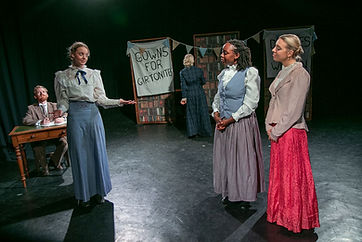
It is a highlight of DP productions that we see a mix of new and established members of the group offering wonderful ensemble pieces. The key central characters; the female students at Girton College, were new members Annabel Datiari and Clemency Wall, together with Chloe Penfold and Emily Tarry (both of whom are now ‘established’ Dulwich Players). All four, very different, characters, were played with panache, excellent stage presence and a seeming understanding of the ways of young ladies of their time. Given that many scenes were rather short, a lot needed to be established in a few glances, smiles and gestures – Annabel’s enthusiasm and energy was particularly engaging. Their relationships strengthened as the play progressed and they faced concerted male efforts to exclude them from Cambridge. These talented actors gave us a glimpse of the pressures faced by women determined to follow their professional dreams in the face of chauvinism, love, and personal tragedies.
Supporting these young ladies were the visionary older women who had paved the way. Gill Daly gave us a firm and dignified portrayal of the Principal of Girton College, Elizabeth Welsh, as she faced numerous setbacks in her crusade to advance women’s education in Cambridge and win the university’s Senate agreement to grant the Blue Stockings the right to be awarded a degree. Making a welcome return to the stage was Hannah Tomlinson playing a Girton College lecturer, Miss Blake. It was she who reminded us that Women’s Suffrage was a looming issue. Her support for the cause ultimately cost her her post. Two strong women who showed all that they had lost while also being trailblazers. And, let’s not forget Miss Bott, played by a rule-bound but worldly-wise Hayley Blundell. Playing the role of a chaperone to ensure the male and female students kept their distance from each other, Hayley’s occasional raised eyebrows and knowing looks let us know that she was not quite the prude that the Establishment wanted her to be.
In contrast to the women were the male characters. It was particularly difficult watching our lovely Dulwich Players playing such short-sighted and misogynistic individuals! Matt Owen (the cad), Sam Rose (the entitled one), Jude Marriott (perhaps too influenced by the others), George Brooke-Smith (the poor, slightly awkward brunt of all the jokes) and Alfie Robinson (he wanted to fit in) played students convincingly with unique characteristics and late nineteenth century boisterousness. But what an obnoxious lot! Sam gave a particularly noteworthy performance as a smooth, entitled chauvinist whose violent words and actions epitomised the views of many men at the time. Caught between the social norms and his love for Tess Moffat, Alfie’s Will Bennett managed to persuade us that his was, in the end, a sympathetic character who supported the women. Fortunately Mark Kelleher’s character, Mr Banks, also took up the cause of the women but paid a heavy personal price for doing so. Mark’s portrayal as the enthusiastic professor was a joy.
Callum Macphee showed his wonderful dexterity on stage by inhabiting three contrasting characters. The highlight (albeit an uncomfortable one) had to be the obnoxious Dr Maudsley, whose views on women’s education and mental capabilities were to say the least, cringe worthy. But, we have to recall that such views were mainstream at the time and it was this Dr Maudsley who went on to found the Maudsley hospital on Denmark Hill.
This was a big cast production. Holly’s maid was a lovely presence (and what a costume!) and Jude appeared separately as Billy – a very powerful performance. There were good, strong supporting roles from newcomer James Parrish, the vintage Roger Orr as Professors Collins and Radleigh respectively; both of whom reflected the male views of the age. Phoebe-Ann Morgan, Clarisse Hassan, Charlotte Holmes and Chloe Jones also deserve mention; it’s not easy playing such parts when you may have to wait ages to come on and have a couple of lines (or none) but slip into a character that adds to the overall production and does not distract. They did it with aplomb and were also responsible for the many scene changes which occurred seamlessly.
Costuming and making-up such a large cast with multiple roles must have been a major issue. The costume detail was spot on with bloomers and boaters giving us a sense of the later nineteenth century so well done to Heather Wilcox, Kate Boydell and Rebecca Dallaway. Making a welcome return was Maddy Jones developing a range of period hairstyles and makeup.
This was not an easy play to stage. It was full of short episodes or vignettes which required numerous blackouts – probably too many. The crew did an admirable job with the scene changes and the set was very evocative. (Ian and Paul can be contacted separately to talk about how integral ‘their’ bookshelves were….) These blackouts were gamely covered by the Maestro, Paul Grimwood, bashing out a selection of late 19th century popular tunes, and some classical extracts, on a rather old upright piano. Time and experience have shown the DPs that plays that run for longer than two hours are a theatrical marathon for our audiences, many of whom are not in the first bloom of youth. As such, it is always worth considering where cuts in the script can be made. Admittedly, it’s not easy in such a complicated play as Blue Stockings which covers a multitude of themes but its worth close consideration by future directors.
Sound can be a difficult area to critique in a play like this. Suffice to say that it was spot on and added to the atmosphere rather than taking centre stage. The only other observation concerning the staging concerned the lighting. There may have been limitations imposed by our use of this new venue in St Dunstan’s but, too often, the actors appeared to fade into darker areas of the stage where faces were hard to see. A good motto for any actors is – Find The Light, and look out to the audience – we want to see your faces.
Overall, Rebecca, the cast, crew and creatives can congratulate themselves on staging an enjoyable and thought provoking production. Shockingly, it was not until 1948 that women were awarded degrees in Cambridge. The audience reaction at the end of the evening, enthusiastic comments on social media and word of mouth reviews were very positive. As ever, we look forward to seeing all these people in future Dulwich Player offerings again soon.
We could not end this review without mentioning the beautiful song at the end. Sadly Emily’s character left her course at Girton early but she delighted us with a solo to close the show. What a voice! And then came the harmonies. Well done to all involved!


